Audrey Watters, tell us how you really feel!

Audrey’s throwing down. And she has some solid arguments. I just read The Stories We Were Told in 2018 (and others) from Hack Education, which might be summed up as, “we think we’re improving schools by using technology, but in fact we’re just enabling the systematic surveillance of our students.”

Ouch.

Watters hits close to home in several areas. I think of a survey we’ve down now for two years to find out how engaged students are in school (and what makes them feel engaged), for example. The goal is to use that data with other data sets, such as grades and test scores, to get to know students better. The promise is that data software tools will “see” things that we’re missing. In the presentations I’ve seen so far, I worry about how well one can ever truly capture who a person is via a survey. And that one answer to a question, say, that might have been poorly worded (or misunderstood) gets fed into the algorithm and you end up with at best an incomplete and at worst an incorrect conclusion.

And, of course, I worry about Google (weird that I was honestly somewhat nervous to post those words just now) and the other companies to which we are entrusting so much data. Our school district is taking student data privacy very seriously, as are many. Starting next year, teachers may only have students create accounts with companies that have a signed agreement about how they protect data. But how much confidence can we have in anything once it’s entered cyberspace?

But, to push back…It’s stating the obvious, but it must be said: giving every child a laptop is not now and has never been the solution to anything. It’s what they’re doing with the tools (and that’s not unique to newer technology– it was no different with pencils). I’m proud that our district puts a huge emphasis on teaching and learning strategies. It always starts with learning; the integration of technology is just a logical part of that.

For right now, the lesson for me is: be more careful, but cherish the truly powerful ways in which technology has enriched students’ lives and learning.
Essential Conditions

Once again, I’m finding the work in my course aligning perfectly with my work at school. This time, it’s about technology planning. As it happens, it is time for us to update our technology plan for the district, so what better time to review the Essential Conditions as defined by ISTE?

I’ll write here generally– in terms of any school or district, rather than specific to ours. And rather than going through each, I will highlight a few that I think are worth noting.

In the area of consistent and adequate funding, it’s important for schools to remember the an initial outlay of money for a new initiative is not enough. There needs to be a plan for how the initiative will be funded once it becomes a regular part of the budget. How often does a team purchase, say, a set of tablets for student use, without thinking about how those tablets will be maintained and/or replaced when they begin to age? Having a process that recognizes this need from the outset is essential.

Engaged communities are another condition that may get overlooked as districts plan technology use. Schools need to do more than send home the occasional update newsletter. Parents and community members need to be at the table when planning (think of all the expertise missed out on otherwise). And parents need to understand and contribute to a shared vision of the use of technology in education. Inside of our schools buildings, we can sometimes forget that we are surrounded by community members who want to help and whose voices bring important perspectives.

A third condition is ongoing professional development. The key here is “dedicated time to practice and share ideas.”  It’s no secret that so much is asked of teachers, so we need to be mindful to set aside time for trying out new ideas and tools and sharing the results. Many districts do this at the beginning and/or end of the school year, but not enough during. Of course, one obstacle can be what appear to be competing claims for teachers’ attention. However, with good planning, the whole of idea of technology integration is that it can be used to support whatever other goals are being targeted in in-service time.

I’ve written before about equitable access, so I won’t highlight again here, except to say that I’m pleased that ISTE includes this among the essentials.

Gamification, Creativity, and Digital Citizenship

This was an interesting week in my course. We hit on areas that are near and dear to my work. First off, the idea of “gamifying” education. The last course I took at Marlboro College was all about this, and I have been continuing to find ways to incorporate the best aspects of gaming into teaching and learning.

Here are a few things I’ve created along those lines:

A “breakout” type of game where students have to persevere in finding information and solving tech problems (for example, fixing a misspelled URL) in order to continue. For this, I used response validation and custom feedback in a Google Forms quiz.

A fake operating system that gets students who only know Chromebooks to think about how files and applications work on other devices. Here, I used SVG images with clickable regions to emulate the OS.

A game where the user has to retrace their steps backwards to return to staring points. This was my first project in the previous course and I have yet to try it with students because it still needs work. But the idea is to build algebra equation solving skills by getting students to think about “undoing” steps.

The other major topic this week was digital citizenship. This comes at a time when my colleagues and I are working on #digcit for the schools in our district. I think we’ve made a good start and we will be able to reach all teachers.

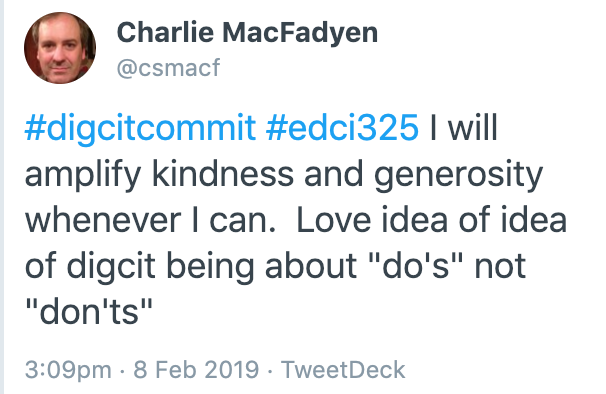
We actually kicked off the year with a #digcitcommit Flipgrid, but I made a new pledge this week (typo and all!):

Reflecting on Social Media

In my course, we’ve been asked to reflect on posts by George Couros and Wes Fryer having to do with the usefulness of Twitter.

I was glad to read these, because both of them address concerns I have had myself about using Twitter and other social media platforms. But both authors make the point that that power and the possibilities for good far outweigh those concerns.

I myself cannot say that I am at the point where I have made close friends out of strangers on Twitter , but I feel acquainted with so many educators whom am I never met or only see infrequently. And the wealth of ideas and resources I’ve gained through Twitter are invaluable.

As Couros points out, there is no shortage of self-promotion on Twitter, but I find it fairly easy to cull through tweets to find the quality posts. It’s also interesting that he mentions his earlier dislike of Twitter chats. I have never loved reading the tweet that begin with “A4”. I guess it’s partly feeling that I’m eavesdropping on a conversation that I’m not part of.  But I also think it’s hard to engage in real time via writing. That may just be me being old, but I find it stressful to try to keep up. It’s a good thing that my class is involved in a Twitter chat as I write, since it’s giving me a chance to re-evaluate that.

Fryer makes the case that with such important problems to solve, we cannot give up on the very tools that give individuals the power to collaborate and effect change.  It is hard not to feel disheartened with all the news about how social media platforms are abused and manipulated, but — with the right level of awareness and caution — it is hard to argue that we should give up on such effective trolls.

One of my classmates has made the point that our students do not all have the skills they need to navigate online discussions. We need to be serious about our duty as educators to help them with this.  And the more we use the tools ourselves, the better equipped we are to do so.

A Leader I Admire

This post is a reply to a prompt about a leader I admire. I thought long and hard about this, and I’m trying not to cheat by mixing together the properties I admire in various leaders I’ve worked with. Maybe the big takeaway from this is that no leader is perfect. I haven’t thought of one single person about whom I can say only glowing, positive things. Which maybe is a lesson for all of us– that we ourselves can’t expect to be the perfect leader and can always strive to improve in our own leadership roles.

Okay, so I’ve come up with my person. What are her qualities?

1. Passion. This person has a clear passion for her work and for guiding others in their work.

2. Energy. This person is always be working hard. Period.

3. Integrity. In some leaders, I wonder about an unspoken agenda.  This can create a stressful and often unproductive environment. This leader is not one of those people. What she says is what she believes. She does what she says she will.

4. Knowledge. This person has a wealth of knowledge about her field and sets an example for others bye continually building on that knowledge. You know when working with her that you are getting well-researched, thoughtful guidance and resources to work with.

5. Selflessness. This person is clearly not in her position of leadership in order to make herself feel more important or respected. Her leadership is all about bringing others up. This is an infectious quality. It is something that you want to pay forward.

Who I Am As A Leader

My job title (Digital Learning Leader) has the word leader in it, so I suppose it’s a good idea to reflect on who I am as a leader. That’s why I’m taking the course this semester. I’m interested to go back and re-read this post at the end of the term to see how I’ve evolved.

I believe in leading by example. I want to be able to say, “do as I do, not as I say.” When I started my new role, I didn’t have a specific classroom teaching assignment. After a year, I requested getting my own class to teach. Why? I didn’t want to lose touch with the life of the classroom teacher– the routines, the systems, and the challenges… but also the joys. When I recommend that a teacher try out a tech tool, I like it when I can say, “Here’s how I used it in my class.”

Specific to leadership in the area of digital learning, I’ve found that it’s essential to “meet people where they are.” No one enjoys feeling intimidated. You can always find a place to start and bring people up from there. I actually wrote a chapter about that in a collaborative book we wrote at the Vermont Fest conference this past fall.

I believe in building consensus. I try to be a good listener. I bring groups together to make decisions. I respect different viewpoints. Something I’d like to work on is recognizing that not everyone will love every decision. Sometimes the role of a leader is to be the one who’s “driving the bus.”

I work closely with other digital learning leaders in the schools in our district. I’m also grateful for the support of the ed tech community here in Vermont and beyond. One area that can be challenging to me is figuring out what things are school-specific, which apply to the whole district, the state, and beyond. I think we often re-invent the wheel; it’s often a question of how customized a wheel we need for a given situation.

Looking over the prompts for this post, I was struck by the question of long-term vs. short-term priorities. I would love to build strategies for ensuring that long-term goals do not get lost when short-term issues arise. This is an area where I think tech tools can be helpful. I’d like to continue to find planner and organizational apps to help me.

I will take George Couros’ advice and not try to make this post perfect at the risk of not ever finishing. I feel that I have more to say, but– as I said earlier– this is a start!

Welcome

I’m starting a new blog.

Probably not the most original first line for a new blog– right up there with “It was a dark and stormy night”– but you have to start somewhere. Which is also how I came up with the name for this blog.

I’m taking the course Technology and Leadership at UVM this semester, which is giving me a kick to get this thing started. I have another blog at cvutechsupport.blogspot.com. But that one is more about sharing specific technology integration tips with teachers at my school. The goal of this blog is to reflect on my personal journey. So let’s get started…